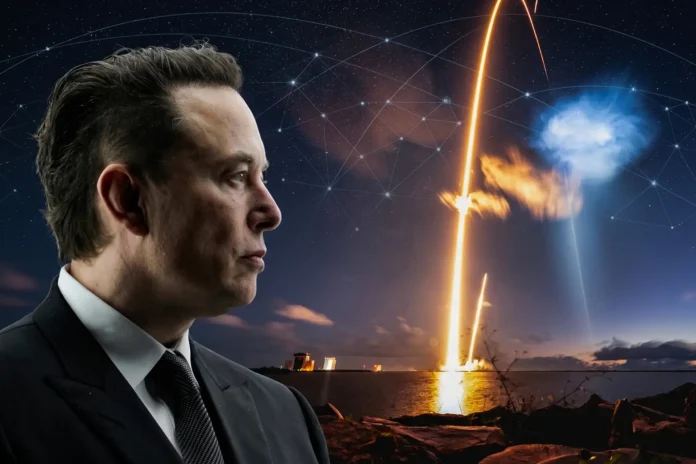
The Federal Communications Commission has authorized SpaceX to deploy up to 1 million Starmind satellites, the first approval in US history for a constellation of data centers in space. The FCC’s Space Bureau granted SpaceX’s application in part on November 25, clearing Elon Musk’s company to build a solar-powered orbital computing network designed to process artificial intelligence workloads above the Earth.
The scale is difficult to overstate. Humanity has launched roughly 28,000 satellites in all of history, and SpaceX’s own Starlink broadband network, already the largest constellation ever assembled, holds just over 11,000. Starmind alone would multiply the number of satellites in orbit many times over, and each spacecraft is a flying data center: SpaceX says each satellite spans 75 meters with its solar wings deployed, carries Nvidia Rubin GPUs and Vera CPUs developed with Nvidia, and links to its neighbors by laser, flying in tight clusters so the machines can pool their computing power.
The authorization comes with a long clock and real conditions. The satellites will occupy orbital shells between 500 and 1,002 kilometers up, and SpaceX must launch its first Starmind satellite by November 25, 2033, reach 10 percent of the constellation by 2035, half by 2038, and the full million by November 25, 2040, or the authorization lapses. The company itself intends to move faster, with CFO Bret Johnsen saying SpaceX plans to launch its first space data centers in 2027. The FCC also limited SpaceX’s radio license to backup and emergency control signals, and it deferred the company’s request to park retired satellites above 600 kilometers in graveyard orbits instead of burning them up on re-entry.
The approval survived a fight. Amazon’s Kuiper Systems, Viasat and the American Astronomical Society all petitioned the FCC to deny the application, raising orbital debris, congestion and the fate of the night sky. The FCC denied the petitions and said the astronomy concerns sat outside its authority, a response the Astronomical Society called disheartening. FCC Chair Brendan Carr framed the decision as infrastructure policy: “Compute campuses or data centers are essential to sustaining America’s leadership in artificial intelligence. By moving compute capacity beyond Earth, SpaceX and the many competitors working on their own orbital data centers are meeting the moment.”
Reuters reported the authorization as a landmark for AI computing demand, TechCrunch stressed that a conditional approval is not the same as imminent deployment, and Gizmodo noted that Google and Blue Origin are chasing the same idea. SpaceX’s ambitions have become pop culture fixtures in their own right, from celebrity trips to Starbase launches to the Nvidia hardware at the center of this plan, the same chipmaker whose AI robots learn movement from the moves of Ronaldo, LeBron James and Kobe Bryant.
What the FCC actually approved is a race against deadlines most of today’s AI industry will be transformed by before the first satellite flies. If SpaceX hits even its early milestones, the largest data centers on Earth will have competition overhead within the decade.