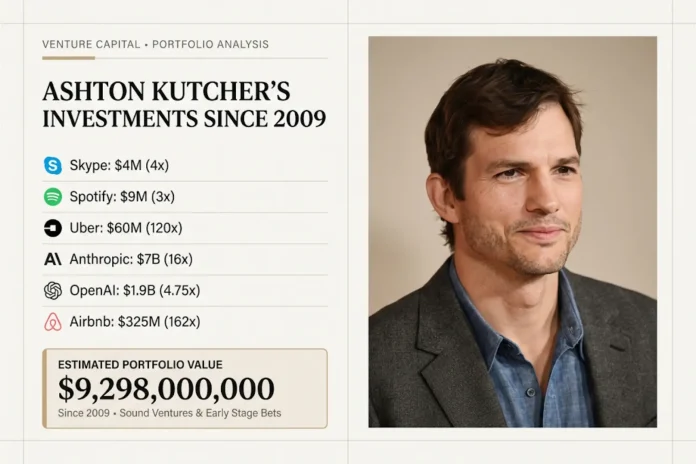
Sound Ventures, the venture capital firm Ashton Kutcher co-founded with talent manager Guy Oseary, holds a stake in Anthropic that Bloomberg estimates at about $7 billion, after the maker of the Claude chatbot completed the largest initial public offering in history on Thursday. The firm invested about $435 million in Anthropic across several rounds beginning in 2023. At the $83 IPO price, The Wall Street Journal put the value of the position higher still, at about $7.5 billion, a return of roughly 16 times the money in.
The debut itself was the kind Wall Street rarely produces. Anthropic priced its offering at $83 a share on Wednesday, above the marketed range of $70 to $78, and upsized the deal to 980 million shares after orders came in at more than six times the amount planned. The sale raised $81.3 billion, overtaking SpaceX’s $75 billion listing in June as the biggest IPO on record. Shares opened Thursday on the Nasdaq under the ticker ANT at $111.50, up 34 percent, touched $115.10, and closed at $97.17, a first day gain of about 17 percent on a session when the broader market fell sharply. As Morningstar’s debut coverage noted, Anthropic is the first pure-play frontier AI lab to go public, five years after its founding and barely two years after it was valued near $20 billion. Its great rival, OpenAI, is not expected to list until 2027.
Sound Ventures got in early, and through the front door of Oseary’s house. In 2023, Anthropic chief executive Dario Amodei spent hours at Oseary’s Beverly Hills home discussing AI safety and the company’s ambitions with Kutcher, Oseary and Sound Ventures managing partner Effie Epstein. The introduction had come through Salesforce Ventures, according to reports, in a period when Anthropic was still an obscure competitor staffed by former OpenAI researchers. Sound Ventures committed about $35 million in the Series C round, when Anthropic was valued around $5 billion, then added roughly $400 million more across later rounds as the valuation climbed, through a round in May 2026 that valued the company at $965 billion. Bloomberg reports the firm now owns approximately 0.5 percent of Anthropic.
The Anthropic bet was the second half of an unusual double. Sound Ventures had already invested heavily in OpenAI, more than $400 million by Bloomberg’s reporting, with a leaked capitalization table earlier this year suggesting a stake of about 0.15 percent. Backing a direct competitor is the kind of move venture firms traditionally avoid, and Kutcher did not make it quietly: according to Bloomberg, he sought and received permission from OpenAI chief executive Sam Altman before Sound Ventures wrote the Anthropic check. Few firms on earth sit on both sides of the AI race’s defining rivalry. After Thursday, that position looks less like a conflict and more like a hedge that paid off twice.
None of which means Kutcher personally made $7 billion, a distinction much of the week’s coverage has blurred. The stake belongs to Sound Ventures’ funds and the outside investors, its limited partners, whose money the firm manages. Kutcher’s own economics depend on his share of the firm’s carried interest and the terms of his departure from the partnership, and none of that has been disclosed. Published scenario estimates, working from the reported stakes in both AI labs, have put his combined pretax paper gains somewhere between about $161 million and $536 million, with a middle case near $322 million. Pre-IPO estimates of his net worth generally sat in the hundreds of millions, around $500 million in the most cited counts. Whether the IPO makes him a billionaire, a status Forbes has formally confirmed for only a small club of entertainers, Beyoncé being the most recent, is a headline the available numbers cannot yet support.
The timing adds its own twist. Kutcher stepped down as a partner at Sound Ventures in July, in a transition the firm had announced in May, and remains a senior adviser while Oseary runs the firm with Epstein. The Wall Street Journal reported the split was partly strategic: Sound Ventures had been drifting toward larger, later stage deals, and Kutcher wanted to return to early stage investing. His new firm, Decimal Capital, co-founded with Morgan Beller, a former general partner at NFX who co-led Meta’s Libra cryptocurrency project and previously worked at Andreessen Horowitz, is built for exactly that. It is seeking about $500 million for its first fund, according to investor materials reported by WSJ Pro, aimed at early stage AI infrastructure, energy and deep tech, the data centers, power and chips the AI boom physically runs on. Oseary marked the separation on Instagram in musical terms: after 20 years of making music together, he wrote, it was time for solo albums, and maybe one day a greatest hits tour.
Kutcher’s own public reaction, in a post on X captured by TheWrap, reached back over the whole arc.
“People usually see the one deal and think that’s the whole thing, but the ones who know realize that it’s years of work, micro victories and failures stacked on top of one another. It’s really the manifestation of trust,”
he wrote, congratulating Amodei and the Anthropic team and thanking the firm’s limited partners.
“Kind of cool when that works out,”
he added.
“And thank you to those who didn’t believe in us. You made us work harder.”
The track record behind that sentence is longer than the celebrity investor label suggests. In 2009, Marc Andreessen invited Kutcher to put $1 million into Skype. Microsoft bought Skype about 18 months later for $8.5 billion, and Kutcher’s money roughly quadrupled. In 2010 he co-founded A-Grade Investments with Oseary and billionaire Ron Burkle. When Forbes talked the two partners into opening their books in 2016, the numbers reset how seriously Silicon Valley took them: A-Grade had turned about $30 million into roughly $250 million in six years. A $500,000 position in Uber was worth more than $60 million. A $2.5 million check into Airbnb in 2011 was worth about $90 million. An early $3 million position in Spotify had multiplied as well.
The failures are part of the same ledger, and Kutcher has never hidden them. A-Grade backed Fab.com, the design retail startup whose paper value soared to $1 billion before it collapsed toward a fire sale, and BlackJet, the private jet membership service that folded. Those are the failures in the stack he was describing on X, the ones that sit underneath Skype, Uber, Airbnb and now Anthropic.
The home front supplied the skepticism early. On The Late Show with Stephen Colbert in 2021, his wife, Mila Kunis, retold two verdicts from early in their relationship. Her father had been a cab driver, and when Kutcher described a company where anybody could drive a cab, she told him,
“That’s the worst idea ever.”
Bitcoin got the same treatment:
“Well I think this is a horrible idea,”
she recalled saying, before he answered,
“Cool, we’re investing in it.”
Her conclusion has become the family motto on the subject:
“I’ve never been happier to be wrong.”
Sound Ventures, launched in 2015 with $100 million from Liberty Media, turned the A-Grade run into an institution, raising a dedicated AI fund of about $240 million in 2023 whose first positions were OpenAI, Anthropic and Stability AI, and growing to a reported $2 billion under management by 2026. Kutcher’s public life has never been only term sheets, either. HypeFresh readers last saw him in a very different register, helping shield a friend’s house from a Los Angeles wildfire. But the Anthropic week belongs to the investor version, and it reframes his next act: the man who made his name getting early into consumer internet companies is now, through Decimal Capital, betting on the physical infrastructure underneath the AI era, while the largest venture win of his career sits in the funds of the firm he just left.
Exact personal proceeds from the Anthropic position remain private. The public numbers belong to the fund and its limited partners. What is visible is a track record that stretches from Skype through the consumer internet era into the current generation of frontier AI labs, and a $435 million decision, made around a Beverly Hills table in 2023, that turned into the defining line on the ledger.