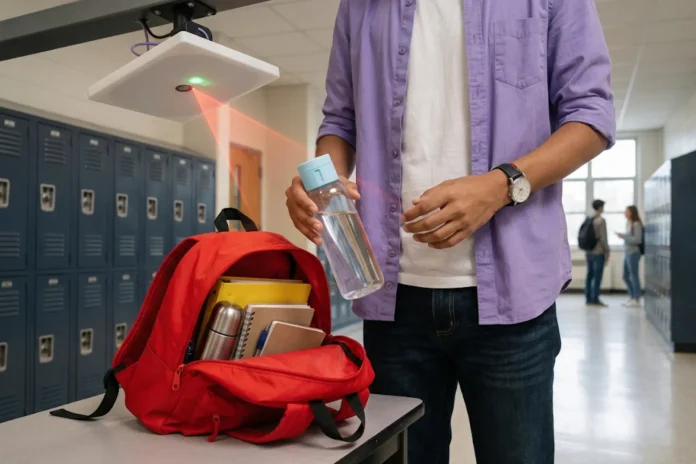
A Pennsylvania high school has ended its trial of an AI weapons detection system after the technology kept mistaking ordinary school supplies for guns. Hempfield Area High School in Westmoreland County had been testing Wi-AI, a system built by CurvePoint, a Carnegie Mellon spinout, and school officials have now agreed with the company that the product is not ready to go live.
Wi-AI works differently from a walk-through metal detector. It reads reflections of Wi-Fi signals as people pass near sensors called SensePods, tracking movement without cameras, and is designed to spot weapons concealed in bags or under clothing. Hempfield was one of several schools that agreed to test the system, hosting it at entrances as a testing and evaluation site rather than relying on it as an operational security system.
In practice, the system kept flagging the contents of ordinary backpacks. Binders, metal water bottles and battery packs were routinely identified as weapons, according to WTAE-TV in Pittsburgh. “The detection is not what they were hoping to get from the technology side of things and so, we are in agreement that, moving forward, as far as going live, its just not a product that is ready for that activation,” Superintendent Dr. Mark Holtzman told the station, as Dexerto reported. Holtzman added that the system’s accuracy was nowhere near the 95 percent the district had hoped it would reach before it could be considered as the school’s primary detection system.
CurvePoint did not dispute the outcome. Chief executive Skip Smith said Hempfield had served as a testing and evaluation site rather than an operational deployment, and that the company is continuing to develop the technology with no deployment date to announce. The district will keep using the OPENGATE walk-through weapons detection equipment it already had in place, and Holtzman said it expects its money back because the system did not meet the threshold set out in its contract.
False positives in this category are not a harmless glitch. In October 2025, a 16-year-old student in Baltimore was swarmed by armed police after an AI gun detection system flagged a bag of Doritos as a firearm, and that system was shut down about a month later. Every false alarm trains staff to trust the next alarm a little less, the same failure pattern behind cases like the wrongful detention lawsuit over a facial recognition error. Hempfield’s experience is the quieter version of the same lesson: a detection system that cries weapon at a water bottle has not made a school safer. It has just made the morning line longer, and the real alarm easier to ignore.
The gap between the sales pitch and the schoolhouse reality is documented. In a CBS Pittsburgh report in December 2025, CurvePoint chief executive Skip Smith put the system’s then-current accuracy at 95 percent, with a false-positive rate of about 4 percent during testing. A year on, Holtzman was blunt about the Hempfield numbers: “It’s not near 95%, I could tell you that much,” as TechTimes reported. Smith’s own conclusion was that the technology had not demonstrated the consistency and reliability necessary for operational deployment. The episode fits a wider public wariness about automated surveillance, the same unease behind stories like the Virginia woman shocked by a mystery Flock surveillance pole outside her home.