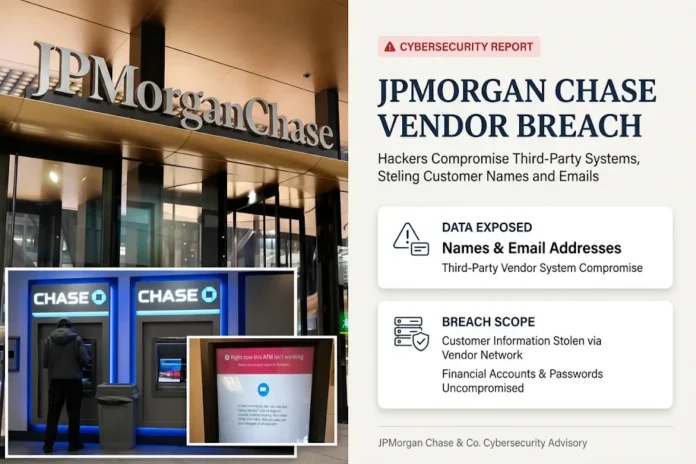
JPMorgan Chase confirmed on Thursday that hackers targeting third-party vendors exposed marketing data tied to its invitation-only Reserve card, including customer names and email addresses for roughly 16,000 of the bank’s wealthiest clients.
The statement, posted on X, said the attackers “accessed certain marketing data held by those vendors” and that there is no disruption to the bank’s services. JPMorgan Chase said it will contact affected customers directly where appropriate and offer complimentary credit monitoring. The bank stressed the incident has no connection to the service disruption some customers experienced earlier in the week, which regulators traced to a software bug rather than a cyberattack.
The confirmation followed the publication of a data file by the extortion group n0n, as Newsweek reported. Researchers at Cybernews, who examined the material, said it contained roughly 16,000 customer email addresses linked to the bank’s Reserve card program, along with some phone numbers, account IDs and more than 100 bank employee email addresses. The published file measured about 502 kilobytes, and it remains unclear whether the release represents a sample or the full set the group holds.
The Reserve card is an ultra-exclusive Visa product typically offered to clients of J.P. Morgan Private Bank who maintain substantial assets under management, commonly reported around $10 million or more. The leaked records appear to consist of marketing and engagement data rather than core account information: campaign interactions, member directory elements with categories and postal codes, and branded marketing emails.
n0n first appeared in mid-to-late September 2026 and quickly built a high volume of claims on its leak site. Researchers describe the group as relying primarily on compromised or weak credentials: credential stuffing against VPNs and remote desktop services, long-lived cloud keys, and information stolen by infostealer malware, rather than novel software exploits.
The group has also used generative AI tools to generate scanning and reconnaissance scripts. One operator’s exposed workspace showed more than $7,000 spent on large-language-model services. Claim counts have sometimes appeared inflated, with security firms noting cases in which batches of listings appear to stem from a single compromised intermediary rather than dozens of independent breaches.
Visa was listed in the same wave of claims and confirmed a separate third-party incident in the Asia-Pacific region involving similar marketing and premium cardmember data. Visa stated that its own systems and payment-card numbers were not involved.
“Visa’s systems were not involved and were not impacted,” a Visa spokesperson said, per Cybernews. “There is no indication that payment data such as card numbers have been affected.” Parallel claims against Mastercard and other firms point to a pattern of shared or overlapping third-party marketing and data platforms rather than simultaneous direct breaches of the major institutions’ core networks.
Even a relatively modest set of contact details belonging to ultra-high-net-worth individuals carries elevated value for targeted phishing, social engineering or business-email-compromise attempts. A scammer who knows a customer holds a premium Reserve card can write a far more convincing fake email than one that simply says “Dear customer.”
The inclusion of employee email addresses raises additional internal-risk concerns, including help-desk impersonation. As Chick-fil-A urged customers to do after its own breach, resetting credentials matters; regulatory notification obligations may be limited if the data lacks passwords, Social Security numbers or full financial credentials, yet the reputational and customer-trust impact remains.
Separate from Chase’s recent money-glitch saga, the earlier service disruption that began around November 16 was caused by a software bug in on-premises hardware systems. It delayed transactions, affected online banking and Zelle for some customers, and produced knock-on effects at other banks. Regulators, including the Office of the Comptroller of the Currency, quickly determined the outage was not cyber-related, and the bank resolved the issue relatively swiftly.
No payment-card numbers, account balances, transaction histories or core banking systems have been reported as compromised in either incident. The timing of the n0n listing and the software-bug outage generated early speculation that the two events were linked, but both the bank and independent researchers have separated them.
The episode underscores a concentrated risk created by the banking sector’s reliance on specialized third-party marketing and data platforms for premium and high-net-worth programs. As HypeFresh has covered in a string of recent breaches, the weakest link is often not the big brand itself but the vendor quietly holding its customer data.
The Reserve card is an invitation-only Visa credit card available to J.P. Morgan Private Bank clients, generally requiring around $10 million in assets under management. The n0n extortion group first appeared in September 2026 and has listed dozens of organizations on its leak site, often after a 48-hour countdown for the named companies to negotiate.