

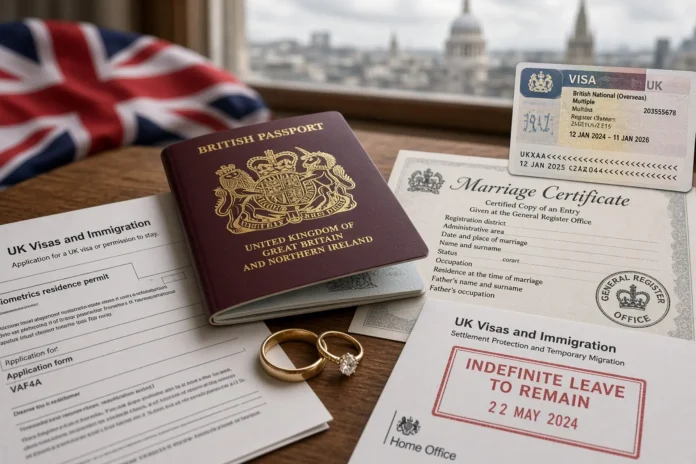
On 2 November 2026 Home Secretary Shabana Mahmood announced that permanent settlement in the UK will no longer be automatic after five years. Most applicants will face a ten-year default under the new earned settlement model. Partners of British citizens retain the existing five-year route to Indefinite Leave to Remain, keeping a clear path for UK residency through marriage.
Couples seeking UK residency through marriage have several family visa options under Appendix FM. The spouse or civil partner visa grants the right to work and study for up to 33 months when applied for from outside the UK, or 30 months from inside. A fiancé or fiancée visa allows six months to marry in the UK before switching to the spouse route. Unmarried partners who have lived together for at least two years can also apply. A marriage visitor visa permits a wedding but requires the visitor to leave afterward and does not lead to residency.
Both partners must be 18 or older. The relationship must be genuine and subsisting, proven with a valid marriage or civil partnership certificate, joint tenancy agreements, shared utility bills, bank statements, travel records, and photographs from events. Previous relationships must have ended permanently. The couple must intend to live together in the UK and provide evidence of adequate accommodation that is not overcrowded.
The financial requirement stands at £29,000 gross annual income for applications made on or after 11 April 2024. Income can come from the sponsor, the applicant if already in the UK with permission to work, or a combination. Savings of £88,500 held for six months can replace income. Sponsors receiving certain disability or carer’s benefits use an adequate maintenance test instead. Applicants must meet an A1 English language requirement for the first visa, rising to A2 on extension and B1 for settlement, with B2 applying from 26 March 2027.
After five continuous years on the partner route, the applicant can apply for Indefinite Leave to Remain if the relationship, financial, and English requirements continue to be met and absences stay within limits. Once Indefinite Leave to Remain is granted, a partner married to a British citizen can apply for naturalisation after three years of UK residence under section 6(2) of the British Nationality Act 1981, without the usual 12-month waiting period. Absences cannot exceed 270 days in those three years or 90 days in the final year.
Current fees, last confirmed in the Home Office table dated October 2026, are £2,064 for an application from outside the UK and £1,407 from inside. The Immigration Health Surcharge adds £3,105 for the initial 33-month grant and £2,587.50 for a 30-month extension, for an up-front total of £5,169 per adult on the first overseas application. Settlement costs £3,226. Standard processing runs up to 12 weeks from outside the UK and 8 weeks from inside.
The November announcement confirmed that family members of British citizens will keep their current settlement pathways. Detailed rules are expected in December 2026 with implementation in 2027. Existing Indefinite Leave to Remain holders are unaffected. Partners of people with EU Settlement Scheme status do not receive the same protection under the proposals.
Imperial & Legal, regulated by the Immigration Advice Authority at the highest level, assists couples pursuing UK residency through marriage from initial visa selection through document preparation and submissions for extensions, Indefinite Leave to Remain, and citizenship. Their team handles the subtleties of relationship evidence, financial calculations, accommodation checks, and intent letters, and supports clients facing refusals or complex cases. Official requirements are set out on GOV.UK, with the Home Secretary’s statement available on the GOV.UK news page.
Applicants submit the online form, upload evidence of the relationship, finances, and English ability, and attend a biometrics appointment. Decision letters specify any further information required. Refusals may be challenged by administrative review or, in limited cases, by appeal. Meeting the income threshold and documenting a genuine relationship remains the core of the route from marriage to permanent residency and, for spouses of British citizens, to citizenship on a shorter timetable than most other applicants.
