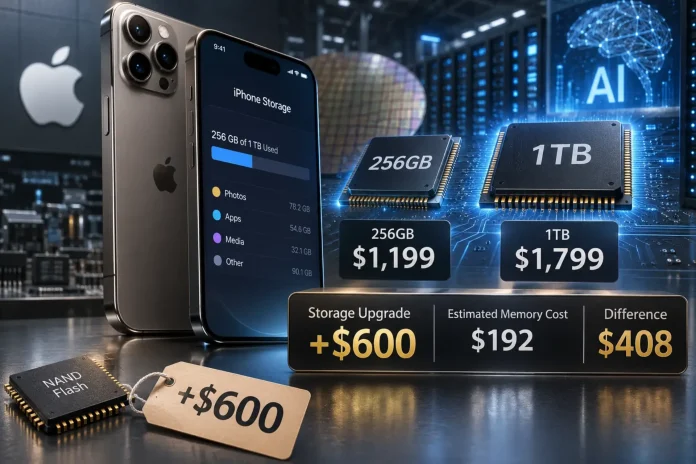
A popular post on Pubity on November 6, 2026, has started a discussion in tech circles based on a Wall Street Journal report. This shows that Apple makes additional charges of $600 for its customers in the U.S. to upgrade their phone from 256GB to 1TB of storage for the iPhone 18 Pro model. However, it would seem that adding the required NAND flash memory does not cost the firm more than $192.
For instance, the U.S.-based price for the iPhone 18 Pro with 256GB storage is $1,199. For 1TB storage, the price increases to $1,799. The price jump can easily be verified on Apple’s site. According to estimates from the industry and the Wall Street Journal, using TechInsights data, this upgrade requires around $192 of extra NAND flash memory.
This $408 does not represent net profits. It merely represents the difference between the retail price of the upgrade and the cost of the components. The costs of assembly, testing, logistics, warranty, software support, and all the other Apple business operations are excluded.
Prices for NAND flash and DRAM have soared. Microsoft, Amazon, Meta, and Google are competing to develop AI data centers and are using more memory than was previously used by smartphone manufacturers. Memory suppliers like Samsung, SK hynix, and Micron find themselves in a situation where they have to cater more to hyperscalers. Volume leverage of Apple has become weaker. It is expected that in 2025, Apple may spend on its flash $6 billion but in 2026 this figure will soar to $25 billion.
Whereas in the case of the iPhone 17 Pro, the increase in cost from 256GB to 1TB increased from $400 at a time when the cost of the components was around $42, resulting in a markup of nearly nine-and-a-half times. For the current generation of phones, the markup in the retail price of storage increased to $600, while the component cost is estimated to have grown to around $192. As such, the markup decreased to three-and-one-tenth times, despite the increase in absolute dollar per upgrade, due to Apple increasing their cost of production by $150.
The criticism is that the various options offered by the company for storage capacity are too many and buyers end up paying way beyond what the silicon chip alone is worth, since this is something that cannot be altered in the future. In fact, Apple itself recognizes the issue of increasing costs of memory. In its recent earnings presentation, it highlighted the high cost of components as an issue that impacts their gross margins adversely, expecting lower gross margins in the current quarter.
AI-fueled demand has increased the real cost of memory in the industry. But Apple is still able to extract a decent margin from the widely favored 1TB jump. From a user perspective, the best option is the entry-level 256GB option along with cloud storage or an external device. The high-end options are selling too, so you can tell that there is willingness to pay despite everything.