

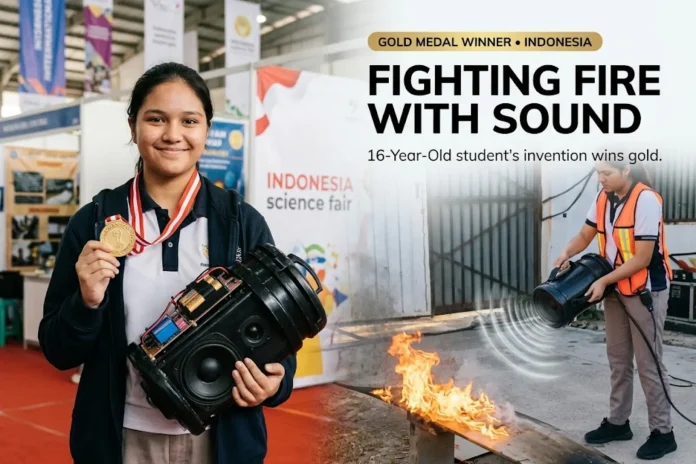
Ángela Karime Hernández Venegas, a 16-year-old student from Altamira, Tamaulipas, Mexico, won a gold medal at the International Science and Invention Fair (ISIF) 2026 in Indonesia with a portable prototype that uses low-frequency sound waves to extinguish small flames without water, foam, or chemical agents.
The device, called Vortex Tech, generates sound at roughly 30 hertz through a 12-volt battery, frequency generator, amplifier, and speaker. Those vibrations form air vortices that disturb the oxygen supply and heat flow around a flame, interrupting combustion. In more than 100 controlled tests, the fifth prototype put out small fires involving wood and liquid fuels in five to eight seconds.
Hernández Venegas developed the project at the Centro de Estudios Tecnológicos Industrial y de Servicios (CETIS) 78 under the guidance of teacher Arturo Hernández Muñoz. She began with a simple goal of silencing a candle flame and refined the hardware over roughly a year. Reports from Mexican outlets note she presented a compact version in Indonesia because of travel constraints and competed as a solo entrant in the Technology category for secondary-level students.
ISIF 2026 took place in Depok at facilities linked to the University of Indonesia, with judging sessions running mid-October. Participant numbers vary across accounts. Some Mexican coverage lists about 110 projects from 25 countries in her category. Indonesian reporting on the broader event cites higher totals across multiple categories and online/offline tracks. Hernández Venegas also received the IYSA Semi Grand Award, which grants entry to another international competition organized by the Indonesian Young Scientist Association.
The concept draws on known physics. Low-frequency acoustic energy can displace air and destabilize a flame under the right conditions, an approach previously explored in laboratory settings and larger experimental systems. Hernández Venegas has said the idea gained momentum after she saw demonstrations of sonic methods. Her version prioritizes portability for small, contained fires rather than structural blazes.
The prototype remains experimental. It has not undergone independent certification for real-world firefighting use and is not positioned as a replacement for standard extinguishers. Mexican President Claudia Sheinbaum publicly acknowledged the result during a morning briefing, and state education officials highlighted the work as an example of technical training at the high-school level.
Hernández Venegas returned to Altamira after the competition. She studies electronics and has indicated interest in further engineering study. The gold medal and special award add to earlier recognitions she earned in state and national innovation contests with the same line of research.
Videos of the device in operation circulated widely after the award, including on accounts that amplified the Daily Loud post. The clips show the red cylindrical unit directed at small outdoor flames, which subside after the acoustic output begins. Those demonstrations match the controlled-test descriptions reported by Mexican media covering the project.
For now, Vortex Tech functions as a student-built proof of concept that earned recognition at an international science fair. Any path toward practical deployment would require further testing, safety validation, and regulatory review beyond the scope of the school project that took first place in its category in Indonesia.

