

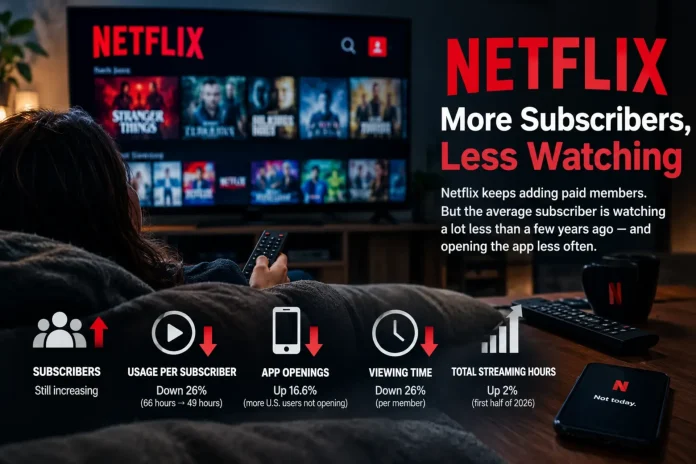
Netflix keeps adding paid members. Yet the average subscriber is watching a lot less than a few years ago and opening the app less often.
According to Bloomberg’s report on October 25, 2026, relying on insiders of the company, customers use Netflix on fewer days every month. Qualified play days measure this indicator. Moreover, the average person watches Netflix for a shorter period of time. Overall, the number of hours of streaming increased by 2% during the first half of 2026 to 97 billion. This growth resulted almost solely from an increased number of subscribers rather than higher individual hours of viewing.
Based on Jefferies estimates, the average monthly viewing time of each member was 66 hours during the first half of 2023. During the first half of 2026, it decreased to 49 hours, which is the decline of 26%. Apptopia’s data also shows that in the third quarter of 2026, the percentage of U.S. subscribers who have not opened the application increased 16.6% year-over-year. This is the relative rise of the non-opening rate, not an increase of 16.6 percentage points.
The introduction of password-sharing restrictions started in 2022 and was fully implemented in the United States in May 2023. This initiative has turned many users into paying customers and led to impressive spikes of the initial signups. Initially, executives have assumed that the reduction in user engagement will be temporary due to reduced number of people using the service per one account. However, it has lasted and raised concerns about reduced value for some subscribers.
Co-CEO Ted Sarandos told investors U.S. viewership “is just not growing as fast as it could or as fast as we’d like.” He said the company does not need a fundamental strategy change but needs better execution in the U.S. Co-CEO Greg Peters has described overall engagement as solid, pointing to low churn as evidence the service still delivers value. Research firm Antenna puts the U.S. cancellation rate at around 2%, among the industry’s lowest.
There is competition with YouTube, TikTok, other streamers, games, and shifting behaviors. There are fewer blockbusters being created by Netflix recently, and the company is doing more with its programming, events, and new formats while also making some management shifts.
It does matter. Usage per subscriber and usage through the app are declining. Usage hours overall and subscribers are still increasing. Churn rates are still very low. This is definitely a decline in engagement that could be a major problem for future retention and ad inventory but is not yet a disaster for Netflix to address.

