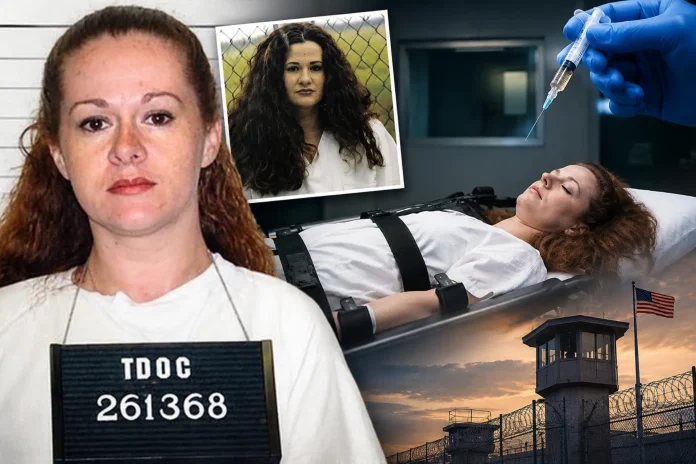
Tennessee’s attempt to execute Christa Gail Pike by lethal injection failed on Wednesday night, September 30, 2026, after officials at Riverbend Maximum Security Institution in Nashville administered both syringes of pentobarbital and could not complete the sentence. Pike, 50, the only woman on the state’s death row and the first woman Tennessee had scheduled for execution in nearly two centuries, remained alive early Thursday at an off-site medical facility. Hypefresh reported last October when the state set the date.
Pike had a detectable heartbeat and could be heard snoring behind the chamber’s closed curtains, according to her attorneys and media witnesses. The Nashville Banner’s minute-by-minute account records the moment the procedure ran past its own script: an ambulance and a fire truck pulled up to the prison with lights flashing, interrupting the media witnesses’ press conference, and Pike left the facility trailed by two white Department of Correction vans.
Her legal team filed emergency motions while the injection was still underway.
“Ms Pike has lost consciousness and still has a heartbeat and is audibly snoring,”
the filing stated, in the wording reported by the BBC. One of her attorneys told the outlet she was “being provided life-saving measures” at the hospital after both syringes had been administered.
The Tennessee Department of Correction said it had followed “every step” of the state’s “lawful, established execution protocol approved by the Attorney General’s Office,” and that the chemical “has consistently been effective, and the protocol does not allow for additional procedures beyond what was carried out this evening.” Read together, the two sentences amount to a state acknowledging it had no written step left once both syringes were used and the inmate kept breathing.
Gov. Bill Lee ordered a comprehensive third-party review and called off the state’s remaining 2026 execution, that of Gary Wayne Sutton, which had been set for December 3.
“Carrying out a lawfully imposed sentence is among the State’s most serious responsibilities, and the people of Tennessee expect it to be done in a manner that is not only legal and constitutional, but is effective,”
Lee said in a statement carried by WSMV in Nashville.
Wednesday’s schedule had already survived a day of court activity. The execution was set for 10 a.m. Central. The Sixth U.S. Circuit Court of Appeals granted a temporary stay less than an hour beforehand, weighing arguments tied to Pike’s claims of childhood sexual abuse and trauma, before the U.S. Supreme Court lifted the stay shortly before 6 p.m. Central in a 6-3 decision, according to the Banner.
Inside the chamber, media witnesses entered the viewing area around 6:41 p.m. Central, and the curtains opened at about 7:27 p.m. Pike spoke with a spiritual adviser and delivered final remarks.
“I’m going to leave this world the way I spent most of my life, and that is in love,”
she said, in the last words recorded by The Associated Press. Witnesses said she complained that a vein in her arm felt as if it were about to burst, and WKRN reporter Tori Gessner saw her point at her arm and ask,
“Does this happen like that?”
The curtains closed at about 7:46 p.m., reopened three minutes later as loud snoring was heard, and closed for the final time around 8:05 p.m. The second dose was administered by 8:26 p.m. Snoring and breathing continued behind the closed curtains until the microphone was cut and witnesses were escorted out at 8:53 p.m., roughly 27 minutes after the second dose.
Pike was sentenced to death in March 1996 for the January 12, 1995, torture and murder of 19-year-old Colleen Slemmer, a fellow student at the Knoxville Job Corps center. Pike was 18 at the time. She and her then-boyfriend, 17-year-old Tadaryl Shipp, and 18-year-old Shadolla Peterson lured Slemmer to a wooded area near an abandoned steam plant on the University of Tennessee agricultural campus, ostensibly to make peace and share marijuana.
According to court records and trial testimony, the group beat, taunted and cut Slemmer with a box cutter for roughly 30 minutes. A pentagram was carved into her chest while she was alive, and Pike struck her head repeatedly with a chunk of asphalt, killing her. Pike kept a piece of her victim’s skull and showed it to others at the Job Corps center; the fragment and a sign-in log led to three arrests within 36 hours, and Pike confessed. ABC News reported she appeared to still be breathing after the two doses were given Wednesday.
Slemmer, born September 20, 1975, in Florida and raised near Jacksonville, had joined the Job Corps program to study computers. Her mother, May Martinez, has described her as a compassionate Special Olympics volunteer who loved helping children. Martinez, who has long sought the return of the retained skull fragment for burial and publicly supported the death sentence, traveled to Nashville for the date. She told NBC News the attempt was “a mess,” adding, “They didn’t say anything, and then, all of a sudden, they asked all the victims to leave.”
Shipp, too young for the death penalty under Tennessee law at the time, is serving a life sentence with the possibility of parole. Peterson pleaded guilty to accessory after the fact and received probation after cooperating with prosecutors. Pike has been held in solitary confinement for most of the past three decades, and in interviews before the execution date she did not deny responsibility for Slemmer’s death, describing the coming day as the end of a long personal ordeal.
Wednesday was the second failed lethal injection in Tennessee in seven months, and the two failures share a through-line the review will confront. The state abandoned the execution of Tony Carruthers on May 21 after medical staff spent more than an hour unable to establish an intravenous line. Dr. Mark Fowler, the physician-contractor involved in that attempt, also oversaw Pike’s injection on Wednesday, as WSMV reported and as NPR’s examination of the execution team’s methods detailed. Between the two failures, the state carried out a successful execution at Riverbend in August, putting Anthony Darrell Hines to death for a 1985 murder.
Pike’s attorneys said afterward that the state had failed to carry out a lawful execution and had been warned.
“We take no pleasure in being right, but the concerns raised by Ms Pike proved to be true: difficult vein access, blown veins, degraded pentobarbital, no emergency medical care available when things inevitably go wrong, all under a protocol that remains veiled,”
they said in a statement to the AP. Her defense team had argued at an August hearing that a vein condition would make access difficult, and the attorneys filed emergency motions mid-procedure asking courts to order life-saving measures.
The failure lands in a national moment where states are rethinking the method itself, with legislatures authorizing alternatives such as Idaho’s firing-squad law after years of drug shortages and failed IV attempts. Tennessee’s electric chair and firing squad remain on the books as backups, but nothing in the current protocol anticipated what happened Wednesday night: a sentence carried to its final step, an inmate still breathing, and no next line to read.
By early Thursday, October 1, neither Pike’s legal team nor the Department of Correction had detailed her medical condition beyond confirming the hospital transport, which officials announced after 11 p.m. Eastern. No new execution date has been set. Pike remains under a death sentence that the state, on Wednesday, could not carry out, while the governor’s review examines the administration of the drugs and the procedures that ran out of steps.