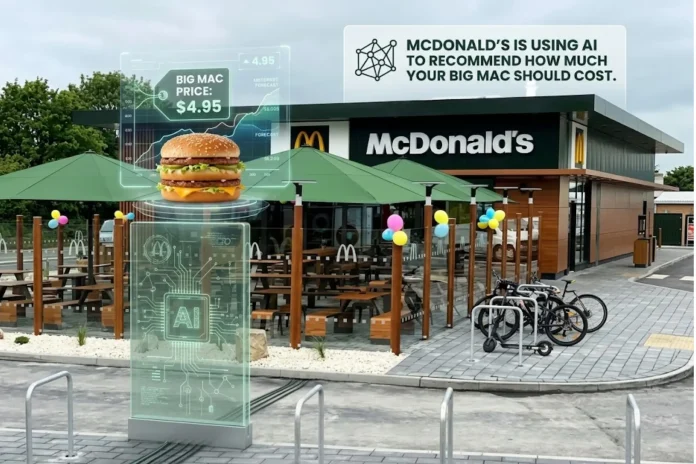
McDonald’s is using an artificial intelligence system to recommend prices for menu items at individual restaurants, including the Big Mac, based on estimates of what local customers are willing to pay and data from nearby competitors, according to a Reuters investigation published Sept. 29, 2026.
The pricing engine relies on machine-learning algorithms that continuously analyze millions of daily transactions across the company’s nearly 14,000 U.S. restaurants. It generates what McDonald’s calls the “optimal price” for each item at each location, Reuters reported.
Screenshots of the franchisee interface reviewed by the wire include messages such as “Your restaurant is showing MEDIUM SENSITIVITY to Price,” drawn in part from assessments of customer willingness to pay in the area. The system also pulls public menu prices from nearby Wendy’s and Burger King locations. Wendy’s and Burger King told the wire they do not use AI for pricing decisions.
The viral-AI aggregator account @interesting_aIl surfaced the report Wednesday morning, drawing more than 130 likes within hours, according to the post’s X syndication data. Reuters separately confirmed the mechanics of the system by checking the McDonald’s app in September: a company-operated store in Fresno, California, was listing a Big Mac at $5.69 while another company-run restaurant two miles away charged $6.89, a 21 percent difference. Reuters said it could not confirm whether the AI recommendations caused the gap.
McDonald’s said in a statement that its pricing portal is “a tool, not a mandate, designed to provide restaurant-specific recommendations to help franchisees deliver value for customers and make informed business decisions.” The company added that costs and market conditions vary even a few miles apart and described the reporting as speculative.
Five store owners told the wire the company has pressured them to follow the AI suggestions. A June franchisee document reviewed by the news agency shows McDonald’s tracks deviations from the recommendations in detail. In January the company began requiring franchisees to be “constructively engaging with McDonald’s approved Pricing Consultant and Tools” as part of updated business standards.
Karen King, a former McDonald’s franchisee who retired from the system last summer after decades as an operator in Florida, said phone calls from corporate officers followed when prices strayed from the guidance. “You don’t really have much of a choice anymore” about pricing, King told the wire. McDonald’s did not address her specific comments.
Chief Executive Chris Kempczinski, the company’s CEO since 2019, told investors in August that pricing non-compliance in certain cases forms part of franchisee business reviews that affect growth opportunities and eligibility. McDonald’s earns most of its profit from royalties on franchisees’ total sales, creating an incentive to favor volume over individual store margins. Franchisees face rising labor, rent and food costs that have climbed an estimated 36 percent since 2019, according to the National Restaurant Association, a dynamic Wendy’s, the chain that told Reuters it does not use AI for pricing, has navigated with a tighter value-menu strategy.
The company has used some form of AI pricing tools since at least 2019. In 2023 Kempczinski told investors the chain had developed proprietary tools to evaluate pricing at individual restaurants. That same year, according to a lawsuit filed by Connecticut franchisee George Michell, the tools suggested charging about $18 for a Big Mac meal at a restaurant along a state turnpike. Michell, who operates dozens of McDonald’s restaurants across several Northeastern states, alleges in the ongoing case that the brand sought to push him out of the system. McDonald’s has disputed the claims and said Michell repeatedly breached franchise agreements. Courts have dismissed some of the breach-of-contract allegations.
Two former employees of Tiger Analytics, which runs the AI platform, told the wire that McDonald’s regularly supplies rules and corporate targets that shape the recommendations. Those parameters have included focusing increases on items that have not risen in price for at least two years and excluding ice cream and soft drinks from summer hikes. Tiger Analytics declined to comment.
McDonald’s terms of service for the pricing portal caution that franchisees “may be competitors of each other” and urge users to comply with antitrust laws, advising them to consult their own attorneys. The company said it takes antitrust compliance seriously. The Federal Trade Commission and Justice Department did not respond to requests for comment on the system.
In recent months the engine has recommended more conservative pricing, including some decreases, after earlier suggestions of larger increases during the pandemic and high inflation. U.S. foot traffic at McDonald’s has declined year-over-year for every complete month since March, according to data firm Placer.ai estimates.
Other restaurant companies are exploring similar technology. Yum Brands, owner of KFC and Taco Bell, is among those turning to AI for pricing and operations. Yum did not immediately respond to a request for comment.
The structure Reuters describes is the same structure antitrust regulators flagged more than a decade ago in the franchise-franchisor pricing cases that came out of the hotel industry. The question for the FTC and Justice Department now is whether the same logic applies: a franchisor using shared data and shared pricing tools to influence what its franchisees charge at a chain with more than 13,000 U.S. restaurants and a third-party vendor running the engine. McDonald’s is not the only company running that experiment, and the refusal of Wendy’s and Burger King to use AI pricing, even as McDonald’s pushes further into automation, suggests the industry’s split on the practice will play out in public before it plays out in any courtroom.