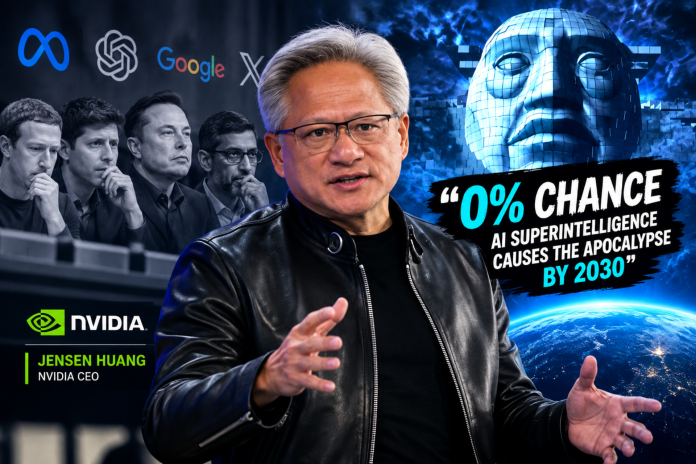
Nvidia CEO Jensen Huang said there is a “0% chance” that artificial intelligence will end the world by 2030, rejecting recent warnings of human extinction from the technology as “doomsday narratives” that are “not grounded in science.”
“2030 is not going to be the end of the world. There is 0% chance that’s going to be the end of the world,” Huang told CBS News senior business and technology correspondent Jo Ling Kent in an interview conducted Friday and aired Sunday on “CBS Sunday Morning.” “Scaring people is unnecessary. It is irresponsible.”
Huang, 63, co-founded Nvidia in 1993 and has led the Santa Clara, California-based company as president and CEO ever since. The firm supplies the specialized chips that power most advanced AI systems and has seen its market value climb above $5 trillion amid the AI boom.
He also pushed back against calls to slow the pace of AI development. “We should go as fast as we can irrespective of anybody else,” Huang said. “We’re going to go as fast as we can, but we would never ever, and never should, ship products before they’re ready, deliver products that are unsafe.”
The comments came days after former Anthropic researcher Jacob Coxon publicly resigned and warned that AI developers “earnestly believe that it could kill us all by the end of the decade.” Coxon, a 27-year-old British mathematician who previously worked on pretraining at OpenAI before joining Anthropic, said in a widely viewed series of posts that neither company was acting responsibly and that the industry was racing toward self-improving superintelligence.
Coxon’s departure helped fuel broader discussion. Anthropic CEO Dario Amodei published an essay calling for the industry to “pace the frontier” and slow the rate of capability advances so safety work could keep up. OpenAI CEO Sam Altman and others expressed agreement with the need for greater caution.
Huang rejected those predictions. He argued that Nvidia’s own success depends on the safe deployment of AI products and services. “Our company’s success is directly connected to the safe deployment of products and services,” he said. “If we don’t continue to do that, our value would be diminished.”
Born Jen-Hsun Huang on Feb. 17, 1963, in Taiwan, Huang moved to the United States as a child, attended school in Kentucky and Oregon, earned an electrical engineering degree from Oregon State University and a master’s from Stanford, and co-founded Nvidia with colleagues Chris Malachowsky and Curtis Priem. He has long maintained that AI risks can be managed through engineering, testing and existing product-liability laws rather than new regulations or coordinated industry slowdowns.
In the same interview, Huang said existing U.S. laws on product liability and cybersecurity are sufficient and that he sees no need for additional AI-specific rules. He also reiterated support for rapid American progress in the technology, including competition with China, while stressing that companies must not release systems before they are ready.
The exchange underscores a clear split inside the industry. Some executives and researchers at frontier labs emphasize existential risks and the need to slow capability growth. Huang, whose company supplies the hardware that enables those labs, argues the risks are overstated and that the priority should remain full-speed development paired with rigorous safety practices.