What if you could jump from a beach in Spain to a busy city street, railway station or nature location somewhere else in the world with one click without leaving your couch?
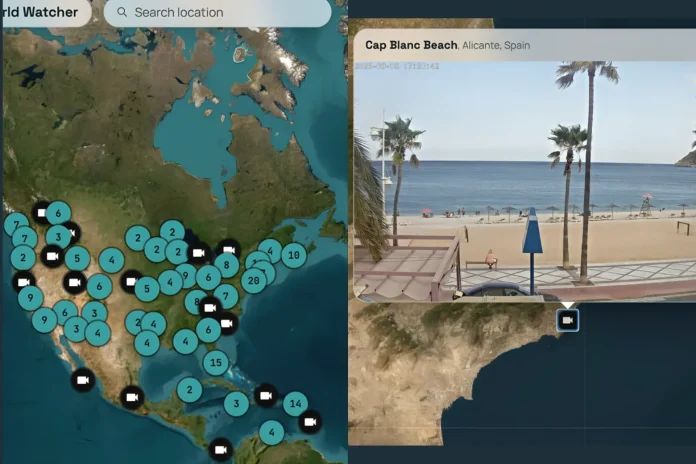
That’s the pitch behind World Watcher, a free interactive map that turns publicly available livestreams into an easy “virtual travel” experience. The site, at worldwatcher.live, places hundreds of live camera feeds mostly continuous YouTube streams from fixed, identifiable spots onto a single global map. Click a marker and the feed loads right there. No new tabs, no hunting individual links.
Dexerto highlighted the site on September 8, 2026, noting 608 cameras at the time. A recent check of the live site showed 604. The total shifts as streams come online or drop offline. Coverage includes beaches, city streets, airports, ports, railways, nature spots, sports venues, religious locations, businesses and urban areas. Filters let users narrow by those categories or pull only sound-enabled feeds. A satellite-map option helps orient each location.
The standout feature is the Explore button. Hit it and the site randomly picks a live camera somewhere on the map. One moment you’re watching waves in Alicante, Spain; the next you’re looking at a railway yard or quiet plaza thousands of miles away. That “where will I land next?” loop is what many find hard to put down.
The project comes from an independent developer who goes by “quinito” on Hacker News. In an August 2026 post he explained the motivation clearly:
“There are a few livecam aggregators that include maps, but I never felt that any of them were satisfying, as they always require you to open new pages to watch the streams. On World Watcher, you can jump from place to place seamlessly.”
He added filters for place types or audio and pointed to the Explore button for anyone who doesn’t know where to go. Inclusion is straightforward any continuous single-camera livestream from a location that can be mapped with reasonable precision.
Live webcams themselves are nothing new. World Watcher does not own or operate the cameras. It simply aggregates public streams that already exist online. Nature and wildlife views appear under the nature filter; specific “safari parks” are not listed as an official category. Streams can go offline without notice because they depend on the original YouTube channels or operators. Privacy questions can still arise even with public feeds, since identifiable people or places may appear.