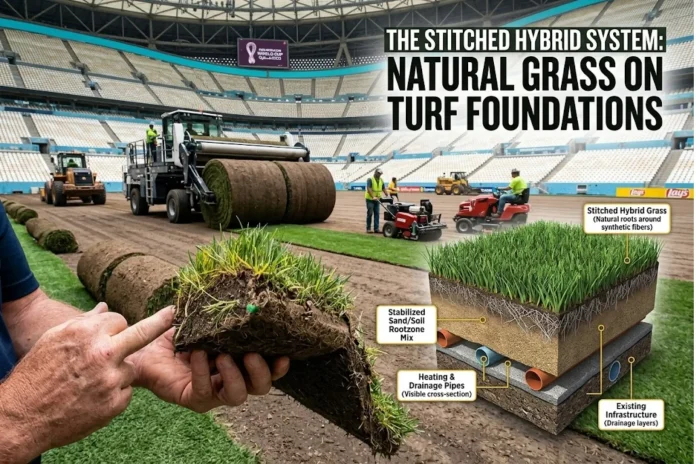
FIFA spent seven years engineering a carpet hybrid grass system (modular natural-grass turf grown on a synthetic backing mat that can be rolled up and installed like carpet) to overlay mostly natural turf onto artificial surfaces at several North American stadiums hosting the 2026 World Cup. This approach directly addresses FIFA’s strict requirement for natural grass while accommodating venues originally built for American football rather than soccer. Eight of the 16 stadiums feature permanent artificial turf, and five others have roofs that complicate natural growth conditions, a logistical challenge that also surfaced in the World Cup Supreme Committee’s full refunds to fans amid unrelated tournament controversies.
The significance of the carpet hybrid method lies in its balance of performance and practicality. The system combines 95 percent natural grass with 5 percent artificial fibers woven into a backing layer at the bottom. Those fibers stabilize the product during harvest, rolling, transport, and installation, reducing the risk of shifting or instability that could occur with pure natural sod. This temporary overlay delivers the playing benefits of natural grass, including better traction and ball behavior that support player safety, while preserving the underlying artificial surface for continued use after the tournament.
Producing enough grass for multiple full pitches requires coordinated supply from several specialized sod farms across the United States, Canada, and Mexico. For the Los Angeles venue, production occurred on a farm in Washington State where the grass matured for about 12 months before harvest. Other farms supplied custom mixes suited to different climates and stadium conditions, ensuring sufficient modular sections could be prepared simultaneously for all participating venues. University researchers collaborated on the underlying science to refine grass varieties, reinforcement techniques, and installation protocols that meet FIFA standards for consistency.
Implementation begins with harvesting the mature grass into large rolls at the farm. Refrigerated trucks then transport the sections, with one documented route from Washington State crossing three states over an 18-hour drive to reach Los Angeles, the same venue that recently hosted Kendrick Lamar’s record-setting SoFi Stadium shows. Upon arrival, crews unroll the ready-play sections directly over the existing artificial turf base. The modular pieces are positioned precisely and secured through stitching to create a seamless playing surface. In roofed stadiums like the one in Los Angeles, artificial light rigs supplement sunlight and compensate for the lack of rainfall, remaining active whenever matches are not scheduled.
Pitch managers, including Lang and his team, conduct daily tests of each surface for hardness, traction, and moisture levels to maintain optimal conditions. During matches they monitor the field continuously and make real-time adjustments as needed. This intensive care treats the grass as a living system that requires constant attention to perform reliably across varying weather and usage demands. The entire process allows FIFA to deliver uniform natural grass playing conditions despite the infrastructure differences in host venues.
The hybrid system demonstrates the scale of preparation required when global soccer events take place in regions where multi-purpose stadiums prioritize durability for other sports. By using this method FIFA achieves both immediate match quality and long-term venue flexibility, as the overlay can be removed afterward without permanent alteration to the original surfaces. This approach may influence future decisions by stadium operators weighing the trade-offs between natural and synthetic options.
Technical details on the installation process and hybrid reinforcement are available through detailed graphics covering the science behind the pitches. Information on the full list of 2026 World Cup venues and surface requirements appears on the official FIFA tournament site. University contributions to the turf science are documented through programs such as those at the University of Tennessee.