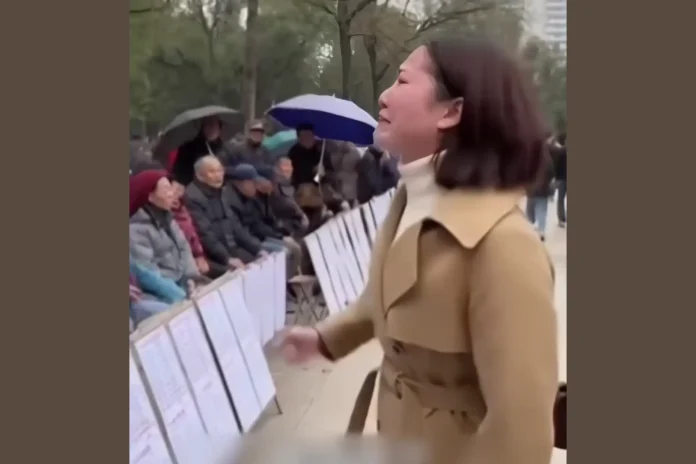
A shaky handheld video capturing a 38-year-old Chinese woman breaking down in tears at a public matchmaking event has gone viral, striking a chord with viewers worldwide about the intense pressures of modern dating in China.
In the roughly 18.9-second clip shared by the X account @nexta_tv on June 17, 2026, the woman dressed in a beige coat over a white turtleneck, with short dark hair stands amid parents seated behind handwritten signs detailing their children’s ages, incomes, education, and assets. She gestures animatedly with her right arm while her voice cracks with emotion. English subtitles capture her words:
“I’m 38 years old. I don’t want to settle or compromise. I have a degree, a good job, and I’m single. I just want to find someone who is also single.”
She continues passionately:
“My annual income is 500,000 yuan why can’t I find someone with the same? I just want someone who is a good match. Why is it so hard?”
The clip, bearing a “CHINA Observer” watermark, shows her tearing up toward the end as she speaks to the crowd.
Out in the open, weekend gatherings called xiāngqīn jiǎo pop up across big Chinese cities. Think Shanghai’s People’s Park, or Tianhou Park in Guangzhou spots where moms and dads hang signs listing details about their grown kids. The footage matches what you’d expect from those unplanned scenes common at such places. Not one trusted verification group has marked it as fake, edited, or made by artificial intelligence. These meetups have been happening for years, passed down through time like old routines.
Who she really is remains unclear. Her earnings, schooling, real estate holdings none confirmed by outside sources. Some accounts point to Shanghai’s People’s Park. Others say the event unfolded in Guangzhou’s Tianhong Park meeting spot. Details clash without resolution.
Out of nowhere, the incident throws light on a loaded phrase used in China – “sheng nu,” meaning women who stay single past 27 or 30. Though successful and well-educated, they’re tagged as surplus by society. A closer look shows this label popped up near 2007, quietly pushed through official news channels. Instead of celebrating independence, it paints eligibility like an expiration date.
Surprisingly, U.S. audiences might find this hard to grasp. Decades of China’s strict birth limits left behind a skewed population many more young men than women available for marriage. Still, customs lean toward older husbands paired with younger wives, which complicates things for accomplished women aiming high in their careers. More females now attend college than males, gaining economic freedom along the way. That shift though? It bumps up against long-held norms about when to marry, how age gaps should work, and who does what at home.
Down to just 6.1 million in 2024, China’s marriage filings tumbled like never before. Year after year it keeps dropping, pushed by tighter wallets and bigger doubts. Life expenses weigh heavy now, making some hesitate. Younger adults see things differently than those before them. What once felt expected now feels optional.
Out here, a woman says she wants a partner who truly fits – her words travel far past that single video. Life today tugs people in different directions: chasing work goals while answering family demands feels harder than ever. Fewer marriages happen now. Roles between men and women keep shifting. People online respond with understanding, yet they argue too about what matters most when picking someone. In cities like Shanghai or Guangzhou, her frustration isn’t rare. These moments tap into wider talks happening across China and everywhere else.