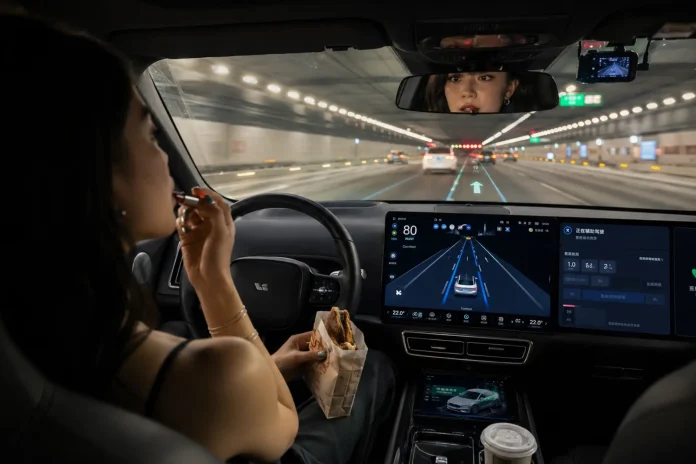
A woman cruises through a tunnel in China, both hands off the wheel. She’s applying lipstick in the mirror, swaying to music, and munching on snacks all while her SUV’s AI-assisted system keeps the vehicle steady. The clips, posted on social media, exploded online and quickly drew the wrong kind of attention.
A woman named Lin, from Wenzhou in Zhejiang, landed in trouble when people sent clips of her drive to authorities. Behind the wheel of a high-end AITO SUV – backed by Huawei and priced near 500,000 yuan ($73,000) she had turned on its smart driving aid.
Drivers nearby flagged reckless behavior to authorities. Officers traced it back to Lin, brought her in for questioning, after which came a 200-yuan penalty about thirty dollars and marks against her permit for blocking clear road movement.
A tweet from X.
When questioned, Lin defended her actions.
“As a female driver, I think the system drives better than I do,”
She told officers. She added that although her hands were busy, she remained
“mentally focused on the road” and “really trust[s] smart driving.”
Backlash came fast. Officials insisted the vehicle’s tech does not drive itself completely. Attention behind the wheel stays critical especially when weather shifts or inside tunnels. A driver should always be prepared to step in without delay.
Drivers often mix things up around this topic. Take Lin’s AITO SUV, its tech falls into the category of ADAS – Advanced Driver-Assistance Systems. These setups manage functions such as staying centered in a lane or adjusting speed based on traffic, yet only when circumstances allow. Still, even then, it’s just level two automation, nothing higher. Fully autonomous, self-driving cars (Level 4 or 5) don’t exist yet for widespread consumer use and would not require any human attention. Chinese law, like rules in the U.S., still holds the human driver fully responsible.
The videos sparked massive discussion on Chinese social media, with related topics pulling in millions of views. Many users slammed the behavior as reckless. Others debated how much trust people should put in today’s “smart driving” features.
Drivers zoning out while cars do part of the job that idea troubles safety watchers. Relying too much on systems that only handle bits of driving might lull people into a false sense of security. In America, questions like these came up after incidents involving Tesla’s Autopilot. Some behind the wheel were found not paying attention or fully unconscious when things went wrong, sparking probes.
Out there, chasing views sometimes means ignoring danger. When risky videos get attention, more folks might try it behind the wheel. What happened with Lin shows something clear no matter how smooth the system runs, control rests with the person sitting up front.
That moment became a lesson for everyone watching. Even when tech helps steer the car, it won’t watch the road like you do. Right now, if your hands drift from the wheel while staring at a screen or mirror, consequences follow.