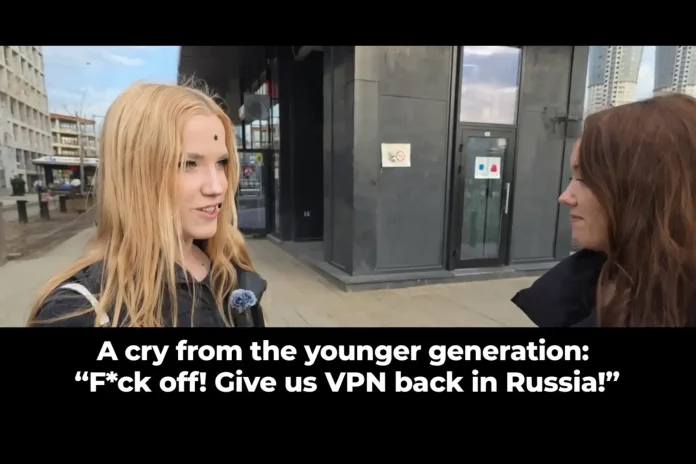
Young women in Moscow have voiced raw frustration over the collapse of VPN access in Russia declaring their digital lives meaningless without the ability to reach Telegram or TikTok. One opens with blunt exasperation saying
“Let’s go to f**k”
before pleading
“Please return VPN to Russia I can’t do it on Telegram”
as others join in with
“And TikTok”
and
“And we can’t make videos.”
The group insists
“We can’t live without VPN”
and appeals
“Can we please return it to Russia”
to restore messaging and content creation while noting they had already paid premiums for the service. Their street interviews on a busy Moscow sidewalk with buildings and pedestrians visible capture a generation that sees smartphones as essential yet fears they will become useless without circumvention tools.
The women elaborate on the practical breakdowns explaining “To go to Telegram” and “To be able to pay a premium for a month” with confirmation that “Yes we completed everything with a premium.” When pressed about a full shutdown one warns “If VPN is completely turned off” and predicts “Bad it’s not a phone it’s a slipper” adding “I don’t need it it will be a brick.” These statements reflect how deeply everyday routines from social connections to financial tasks now hinge on VPNs amid government efforts to isolate the online space. The complaints highlight a turning point where convenience has become necessity for young people navigating restricted platforms.
Russia first moved against VPNs in 2017 when a law signed by President Vladimir Putin required services to block access to banned content or face their own restrictions while outlawing advertising and instructions for circumvention tools. That framework set the stage for repeated escalations including the failed 2018 attempt to shut down Telegram which instead drove millions toward VPNs as a workaround. By the early 2020s authorities had expanded blocks on Western platforms following the invasion of Ukraine forcing reliance on these tools for basic access. In 2026 the campaign reached new intensity with hundreds of VPN services restricted mobile data fees planned for excess international traffic and technical disruptions to popular protocols.
Telegram has long served as a vital platform for protest coordination in Russia enabling opposition figures and activists to organize demonstrations share real time information and bypass state controlled media. During the 2017 Navalny led mobilizations and the widespread anti war protests that erupted after the 2022 invasion of Ukraine the app facilitated polycentric leadership and rapid turnout through channels and groups that evaded traditional censorship. Its encrypted channels became lifelines for dissent allowing users inside the country to connect with the outside world and sustain momentum despite arrests and surveillance. Now as authorities throttle the service and target VPNs that keep it functional Telegram stands at the center of the digital resistance that these young women embody.
The latest measures reflect a sustained push to enforce a more controlled internet environment with Roskomnadzor blocking over 469 VPN services by early 2026 and imposing new obligations on telecom operators. Mobile internet blackouts in central Moscow and payment system failures linked to the restrictions have compounded the disruption underscoring the real world consequences for ordinary citizens. Russian authorities have pursued these controls to limit information flows and promote domestic alternatives such as the state backed MAX messenger. Young Russians who once turned to global apps for connection and expression now confront a narrower digital landscape that feels increasingly severed from the wider world.
This situation exposes the human toll of long standing internet restrictions where the loss of VPN access strikes at personal autonomy for a generation raised on open connectivity. While officials cite security needs the voices in the video illustrate genuine disconnection that extends to banking entertainment and social ties. Public reactions on social platforms mix empathy with debate over the societal price of isolation revealing divided sentiments yet a shared recognition of the stakes. As the government advances its agenda the women’s plea underscores quiet resistance among those unwilling to surrender the tools that once kept them linked to global conversations and one another.
The episode also draws attention to broader implications for freedoms in Russia where digital controls have intensified alongside efforts to contain dissent. Similar frustrations have surfaced in other accounts signaling that the younger generation is not alone in feeling the pinch. Telegram’s centrality in past protests makes its current targeting particularly symbolic of the shift toward tighter oversight. In the end these street level cries may foreshadow wider pushback as the boundary between security and individual expression continues to be tested in an ever more constrained online realm.