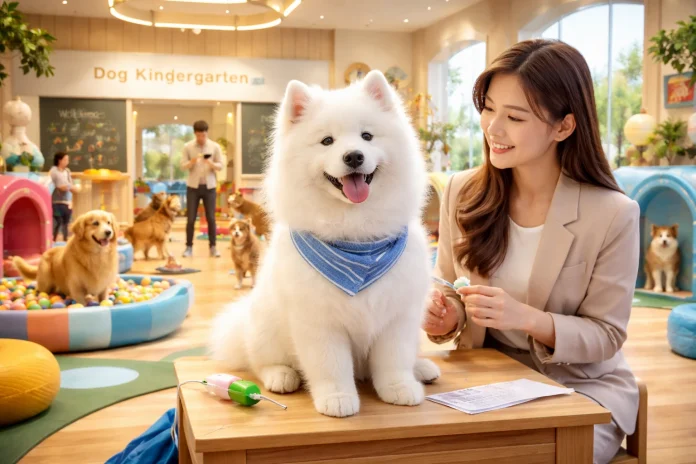
A young professional in Shanghai has sent social media into a frenzy after disclosing that she spends approximately 12,000 yuan (about $1,700) per month to send her six-month-old Samoyed to an upscale “dog kindergarten.”
The woman, who goes by the pseudonym Taotao and belongs to China’s post-95 generation, told local media that her demanding work schedule leaves little time to provide the companionship, training and socialization her energetic fluffy white breed needs. Instead of basic daycare or leaving the pup at home, she enrolled it in a full-day structured program that functions like a human kindergarten — complete with education, play and care.
The premium package includes personality and temperament testing to evaluate the dog’s behavior, daily behavior training to curb issues like barking or stubbornness, supervised group play sessions for socialization, full-day boarding with exercise and health monitoring, and “parent-child” interaction classes where owners can join for bonding activities. A dedicated “school bus” service handles morning pickup and evening drop-off, adding convenience for busy owners. Pet meals are billed separately.
According to Taotao’s breakdown, the daily boarding fee runs around 188 yuan, while the parent-child sessions cost about 368 yuan each, with the remaining costs bundled into the comprehensive premium service. The facility is said to be so popular that it maintains waiting lists of two to three weeks.
For context, standard dog daycare options in Shanghai typically range from 950 to 3,000 yuan monthly, with mid-tier services landing between 3,000 and 6,000 yuan — making Taotao’s choice a notably high-end investment in the city’s booming luxury pet sector.
The story has struck a chord amid China’s rapidly expanding “pet economy,” particularly in first-tier cities like Shanghai. Young urban professionals, often working long hours in high-rise apartments, increasingly treat pets as “fur children” or emotional companions but face challenges balancing that with career demands. The overall pet market in China continues to show strong growth, fueled by services ranging from gourmet food and spas to specialized training and transport.
Online reactions have been predictably mixed. Some commenters expressed disbelief, joking that the dog receives a better daily routine than many humans or questioning how anyone could afford such fees. Others pushed back, arguing that if the owner can comfortably cover the cost and it results in a happier, better-behaved pet, the decision is responsible — especially for a social and sometimes vocal breed like the Samoyed that thrives on stimulation and interaction.
The tale underscores a broader cultural shift in urban China, where declining birth rates and fast-paced lifestyles have elevated pets to family-member status, driving demand for premium care options that mirror human childcare or after-school programs. Similar high-end dog daycares and boarding facilities have popped up in recent years, some even offering group park adventures via specialized transport.
While the price tag may raise eyebrows, the viral story has sparked wider conversations about modern work-life balance and the lengths pet parents will go to ensure their animals receive proper enrichment when time is in short supply. In Shanghai’s competitive pet care scene, it seems spots in top programs are nearly as hard to secure as elite human kindergartens.