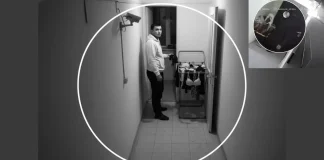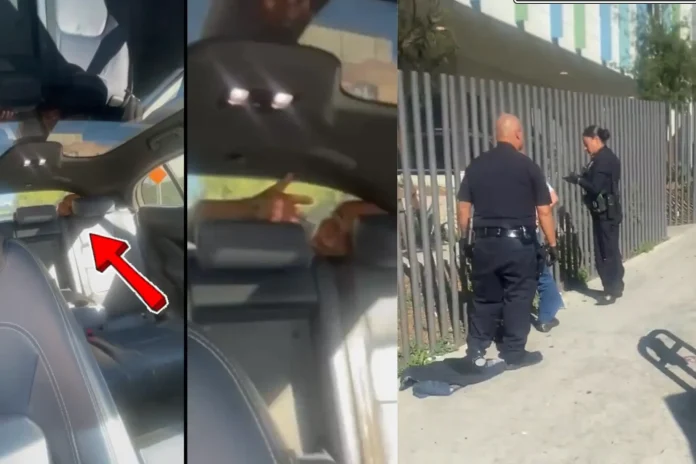
Jessica Arin thought she was doing everything right that Sunday evening. Like thousands of LA parents, she ordered a Waymo for her 15-year-old daughter, Mia, who was finishing an after-school program in Mid-Wilshire. The self-driving Jaguar I-PACE arrived on time, pulled up quietly to the curb near Wilshire and Normandie, and waited with its familiar soft chime. What Jessica didn’t know—what nobody knew—was that the exact vehicle had already picked up an uninvited passenger twenty minutes earlier, one who was curled up silently in the cargo area behind the rear seats.
Here’s exactly how it unfolded, minute by minute.
Around 7:35 p.m., the Waymo dropped off its previous rider a few miles away in Koreatown near MacArthur Park. That passenger opened the rear hatch to grab groceries and luggage, leaving it raised for roughly 35–40 seconds. In that brief window, a man walking along the sidewalk noticed the open, empty robotaxi idling at the curb. He quickly climbed into the deep cargo space of the electric SUV, pulled the retractable parcel shelf over himself like a blanket, and lay still.
Waymo’s sensors—dozens of lidars, radars, and cameras focused on the road, sidewalks, and passenger seats—never registered his presence under the tonneau cover. After the timeout period, the hatch closed automatically, the doors locked, and the car drove off to stage for its next ride, now carrying a hidden stowaway through evening traffic.
For the next fifteen to twenty minutes, the Waymo cruised empty through central Los Angeles with the man trapped but undetected in the back. He later told police that he tried to get out but couldn’t find an interior release, and the car continued to drive.
At approximately 8:05 p.m., Jessica summoned the exact vehicle for Mia. When the I-PACE came to a stop, Jessica walked her daughter to the rear door—a habit she’d developed with robotaxis to ensure the interior was clean and safe. As soon as she cracked the door open, she heard rustling and a low male voice coming from behind the cabin. Instinct kicked in. She grabbed her phone, hit record, and yanked the parcel shelf upward.
The man sat up suddenly, hair disheveled, eyes wide.
“I’m sorry, I fell asleep,”
He stammered.
“I’m not trying to hurt anybody… this thing wouldn’t let me out.”
Jessica’s video—shaky, loud, and raw—captures her shouting,
“There’s a man in the trunk! Get out right now!”
She immediately propped all four doors open with her body and her daughter’s backpack, knowing an open door prevents a Waymo from driving away. While keeping the intruder in sight, she called 911 and kept filming as he climbed out onto the sidewalk, hands raised, repeating that he meant no harm.
LAPD officers arrived within six minutes, detained the man without incident, and cited him for misdemeanor unlawful entry of a vehicle. Because no weapons, threats, or evidence of further intent were found, he was released on-scene under California’s low-level offense protocols. Police later confirmed the onboard cameras clearly showed him entering voluntarily after the previous drop-off.
Waymo responded the next morning swiftly, calling the incident “unacceptable,” disabling the specific vehicle, and pushing an emergency software update on December 10 that shortens hatch-close timing and triggers an alert if more than 30 pounds of cargo is detected in the area after a ride ends. The company also offered Jessica a $100 ride credit—an offer that sparked immediate backlash online, with many calling it insultingly inadequate given the circumstances.
This wasn’t the first time someone had hidden in a Waymo trunk. Similar incidents happened in San Francisco in 2024 and Phoenix in 2023, which is why California lawmakers are now debating Senate Bill 915, legislation that would require interior cameras and occupancy sensors in cargo areas of all robotaxis.
Jessica’s original TikTok videos, posted under the accounts @jessicaurin_ and @luckythurman, have now surpassed 180 million views combined, transforming a terrifying ten-minute encounter into a nationwide warning. Parents across Los Angeles and beyond are rethinking unsupervised robotaxi rides for minors, and many say they’ll follow Jessica’s new rule: always open the door and check the back yourself before letting a child get in.
Waymo continues to emphasize its overall safety record and points readers to its latest transparency report here: waymo.com/safety. The National Highway Traffic Safety Administration is also monitoring robotaxi incidents closely: nhtsa.gov/automated-vehicles-safety.
For now, one mother’s quick thinking and a viral video have compelled the entire autonomous-vehicle industry to confront the human realities of the streets they share a little closer. And in Los Angeles, parents are adding one more step to the evening routine: peek in the trunk first.