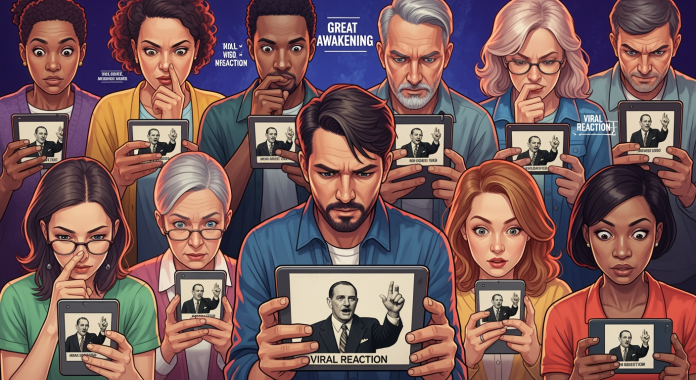
Viral reaction videos to a poignant 1939 speech are sparking discussions across digital platforms, hinting at a potential ‘Great Awakening.’ This unexpected cultural phenomenon sees modern audiences, including Gen Z and millennials, engaging with decades-old rhetoric through a contemporary lens, drawing parallels to current global and societal challenges.
The speech, delivered on the precipice of World War II, touches upon universal themes of resilience, freedom, and the struggle against oppressive forces. Viewers reacting to its powerful message find particular resonance in its calls for unity and warnings against division, perceiving an almost prophetic quality that speaks directly to today’s political and social landscapes.
Social media platforms like TikTok, X, and YouTube are transforming a historical artifact into a living commentary. Short clips, often edited for maximum impact, are amplified by algorithms, reaching millions who might otherwise not encounter such archival material independently.
This digital amplification fosters a diverse array of interpretations. Some viewers see the speech as a clarion call for spiritual or moral revival, associating it with the ‘Great Awakening’ concept that implies a significant societal shift in consciousness. Others interpret it through a purely political lens, applying its historical context to current geopolitical tensions or domestic concerns.
Dr. Evelyn Reed, a renowned digital culture analyst at the Institute for Media Studies, explains the underlying appeal:
“What we’re witnessing is a profound convergence of past and present. Digital natives, accustomed to rapid information cycles, are discovering that historical speeches can offer surprisingly relevant insights into modern anxieties, creating a powerful sense of shared humanity across generations.”
— Dr. Evelyn Reed, Digital Culture Analyst
The conversations extend beyond simple appreciation, venturing into profound philosophical and ethical debates. Comment sections and follow-up videos explore themes of societal decay, the cyclical nature of history, and the urgent need for collective action, transforming individual reactions into a communal introspection.
The trend underscores social media’s potent capacity. It not only disseminates fleeting trends but also resuscitates and recontextualizes significant historical moments. This highlights how digital culture trends can bridge generational gaps, prompting new engagement with the past.
It contributes to an ongoing dialogue about humanity’s future, especially during moments of perceived global uncertainty. The virality of the 1939 speech reaction videos suggests a collective yearning for guidance and understanding in complex times. It reveals that echoes of history, when amplified through modern technology, can ignite significant public discourse and perhaps even influence emerging cultural movements seeking deeper meaning and direction.