

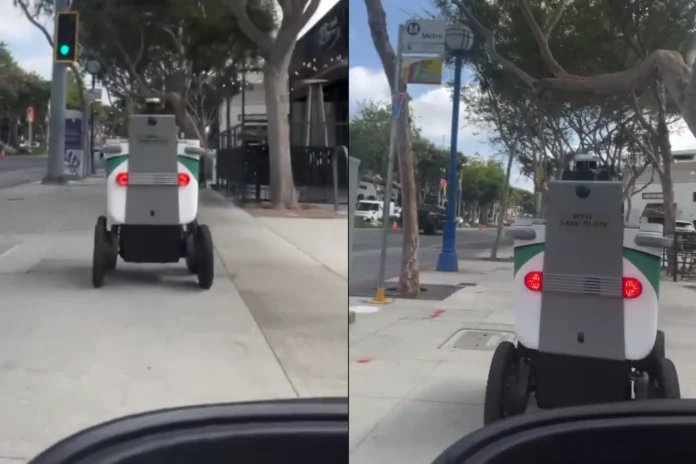
A food delivery robot in Los Angeles has sparked outrage after repeatedly colliding with a woman with cerebral palsy, raising serious questions about the safety of robotic delivery services. Temix Love, who relies on a mobility scooter to navigate the city, shared a disturbing video on TikTok on September 11, 2025, showing a Serve Robotics robot backing into her scooter multiple times on a sidewalk. The robot, which humans can remotely control, beeped loudly and made contact with her, leaving Love shaken and frustrated.
The incident, which gained traction after being reposted on X on September 19, 2025, has ignited a heated debate about the risks of human oversight in robotic systems. In the video, Love is seen trying to maneuver around the robot, which appears to reverse toward her aggressively. She can be heard shouting in distress as the robot continues its erratic behavior. Love, who goes by @temixlove online, later explained on Instagram that the encounter felt like targeted harassment, highlighting how her disability made her particularly vulnerable.
The video has amassed over 2.8 million views on TikTok and thousands more on X, with viewers expressing anger and concern over the incident. Serve Robotics, the company behind the robot, confirmed that a human operator remotely controlled the device during the encounter, attempting to navigate around Love’s scooter.
In a statement released on September 17, 2025, the company apologized, saying,
“We are deeply sorry for the distress caused and are reviewing our remote assistance protocols to ensure safety.”
The robots, primarily AI-driven, switch to manual mode in complex situations, relying on remote operators who use onboard cameras and sensors. However, this incident has fueled public fears that such systems could be misused, with some speculating that the operator’s actions were intentional. Public reaction has been swift and vocal, especially on X, where users have called for tighter regulations on robotic delivery services.
Many worry that operators could exploit cameras for surveillance or target individuals, posing risks beyond physical safety. Disability advocates have also pointed out this isn’t the first time delivery robots have clashed with accessibility needs. Similar complaints have surfaced about robots blocking sidewalks or interfering with wheelchair users, including a 2019 incident in Pittsburgh involving a different company’s robot.
The incident occurred when robotic delivery expanded in Los Angeles, with companies like Serve Robotics partnering with Uber Eats to serve neighborhoods like West Hollywood and Koreatown. However, this growth has not been without challenges. Reports of robots obstructing emergency vehicles and even colliding with each other have raised red flags about their reliability in busy urban settings. Some cities, like Long Beach, have paused robotic delivery operations to develop stricter rules, and Los Angeles may face pressure to follow suit.
Love has used the incident’s visibility to advocate for better accessibility, emphasizing the challenges disabled individuals face in navigating public spaces. While no legal action has been announced as of September 19, 2025, the backlash has prompted Serve Robotics to review its protocols, and the company’s stock has seen a slight dip.
