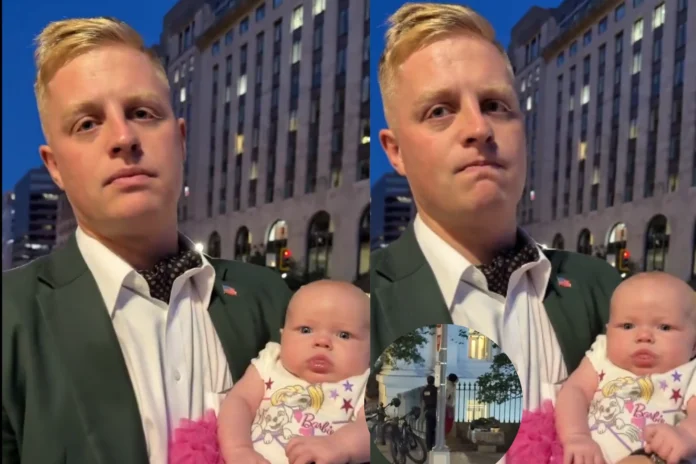
An alleged incident in Washington, D.C., where a Black man reportedly threatened to kill a white couple’s baby, has reignited debates over crime, policing, and racial dynamics in the nation’s capital. The account, shared on X by user @Liberacrat, described a swift police response and arrest—praised by some as a sign of increased safety under President Trump’s law-and-order agenda.
The episode comes amid heightened scrutiny of both the city’s crime statistics and broader racial segregation patterns, reflecting deep social and political divides in Washington.
In August, President Trump declared a “crime emergency” in D.C., sending 800 National Guard troops and 500 federal law enforcement officers into the city while taking temporary federal control of the Metropolitan Police Department.
The move was dramatic, particularly since official data showed violent crime had dropped to its lowest levels in 30 years in 2024, with homicides falling by nearly a third. Still, Trump framed the deployment as a promise kept: restoring “law and order” in the capital.
Federal officers made 23 arrests on the first night, ranging from drug trafficking charges to homicides.
Civil rights advocates, however, say Trump’s crackdown is about more than crime. The American Civil Liberties Union (ACLU) has called his second-term criminal justice policies the beginning of a “new era of mass incarceration.”
According to the ACLU, Trump’s plans would militarize policing, revive aggressive drug prosecutions, and undermine reforms he once touted — like the First Step Act he signed in 2018. Critics warn that such measures could worsen racial disparities without addressing root causes of crime.
Adding to the controversy: the Justice Department is investigating whether D.C.’s police force manipulated its crime data, allegedly downgrading serious offenses and excluding some assaults from official counts.
Trump himself has weighed in, accusing city officials of providing “Fake Crime numbers.” A police commander has already been placed on leave as the inquiry continues.
Segregation and Social Divides
This incident also shines a light on the city’s ongoing racial divides. A report from UC Berkeley’s Othering & Belonging Institute found that D.C. is actually more segregated today than it was in 1990.
While neighborhoods like Adams Morgan and Shaw are considered racially diverse, many other areas — including parts of Maryland and Virginia just outside the city — remain deeply divided. Researchers say segregation is closely tied to health, education, and economic outcomes, especially for people of color.
Whether or not the viral post fully reflects what happened that day, it’s clear the story has struck a nerve. In a city where racial tensions, political battles, and questions of public safety are all colliding, D.C. residents are left to wonder: whose version of “safe” is being protected — and at what cost?