

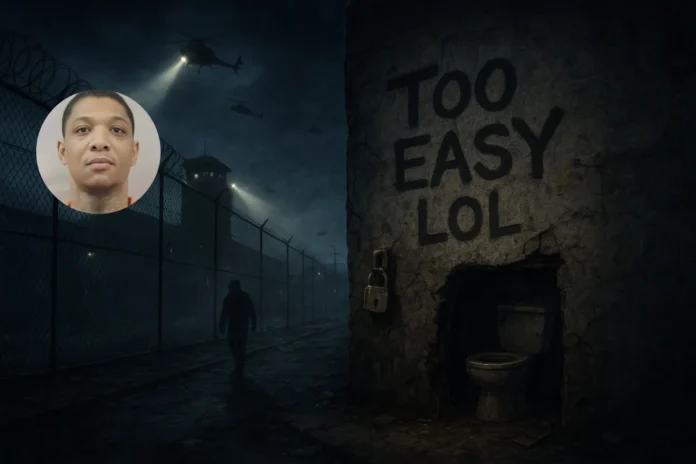
On May 16, 2025, ten inmates vanished from the Orleans Justice Center in New Orleans. They slipped out through faulty locks and a crawlspace carved behind a toilet. When deputies finally discovered the empty bunks during a morning headcount, it had been more than seven hours since the men had scaled the fences.
Graffiti scrawled on the cell wall read:
“Too Easy LoL.”
Nine of those inmates have since been tracked down. One has not. Derrick “Woo” Groves, a 28-year-old convicted murderer from the city’s Lower Ninth Ward, is still out there 104 days later.
Groves was convicted in October 2024 of killing two men 26-year-old Byron Jackson and 21-year-old Jamar Robinson during a 2018 Mardi Gras Day block party shooting. Prosecutors said he sprayed the crowd with an assault rifle, killing Jackson and Robinson and wounding others, part of a feud tied to heroin trafficking.
A tweet from X.
His record runs deep a teenage attempted murder charge, heroin distribution, and repeated allegations of witness intimidation.
“He had a long history of threatening anyone who tried to testify,”
Orleans Parish District Attorney Jason Williams said earlier this year.
Groves’ name also carries a tragic connection. He is the grandson of Kim Groves, a woman murdered in 1994 after filing a complaint against a corrupt New Orleans police officer. Her killing ordered by that officer has been invoked by supporters who frame Derrick’s story as part of a generational injustice. Prosecutors reject that idea.
“That’s an urban myth,”
Williams said.
“What he did is about choices he made, not his grandmother’s murder.”
The jailbreak did not just rattle the city it drove people out of it. Two prosecutors who worked directly on Groves’ case, Assistant District Attorneys Forrest Ladd and Zachary Creel, have left Louisiana along with their families.
“They left town with their families as a precaution,”
Williams confirmed to hypefresh News shortly after the escape. Local station WWL-TV reported that they had moved out of state entirely. Witnesses and victims’ families have also been placed under protection.
For those who survived Groves’ violence, the fear is still real.
“We’ve already lived through the bullets,”
One victim’s relative told reporters.
“Now we’re living through the fear of what happens if he comes back.”
The search for Groves has turned into one of the most extensive manhunts in recent Louisiana history. The FBI, U.S. Marshals, Homeland Security, Louisiana State Police, and local deputies are all involved.
Rewards have shifted over the summer. At one point, Crimestoppers promoted up to $50,000 for information. Today, the FBI’s wanted poster advertises $20,000. Several of Groves’ alleged helpers including his girlfriend, 28-year-old Darriana Burton have been arrested.
But Groves himself has proven elusive. Authorities say he is likely receiving help from friends or family. Search efforts have included the Lower Ninth Ward, where he grew up.
The Orleans Justice Center has been under federal oversight for years, plagued by defective locks, staff shortages, and chronic security lapses. Sheriff Susan Hutson admitted Groves should have been housed at Angola, the state penitentiary, instead of the troubled city jail.
The political fallout has been sharp. DA Jason Williams has clashed with Governor Jeff Landry over who bears responsibility for the escape and how to prevent the next one.
As of today, Derrick Groves is the last man standing from a jailbreak that embarrassed city leaders and endangered public trust. Nine others are back in custody. He alone remains free.
For prosecutors, witnesses, and families, the fear is ongoing. For law enforcement, every day he remains at large is another reminder of the system’s failures.
“Until he’s caught, none of us can rest easy,”
DA Williams said.
Whether Groves is eventually cornered or continues to evade capture, the case has already forced New Orleans to confront its deepest vulnerabilities unsafe jails, fragile trust in justice, and the peril faced by those who dare to hold violent offenders accountable.

