

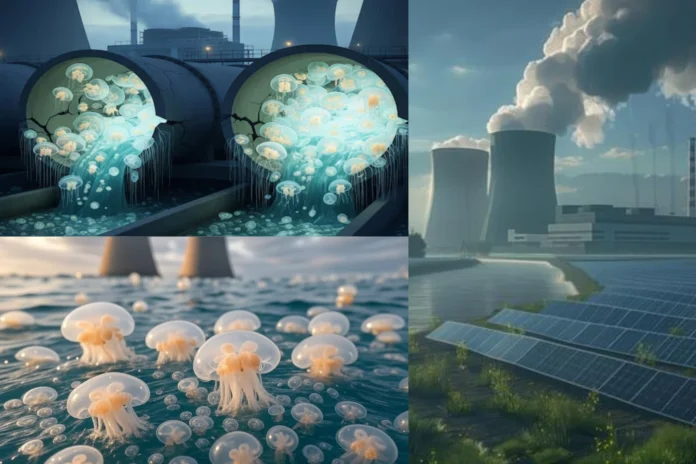
A vast swarm of jellyfish brought one of Western Europe’s largest nuclear facilities to a complete standstill this week, forcing the shutdown of all six reactors at France’s Gravelines nuclear power plant.
The disruption began late Sunday night, August 11, when what plant officials described as a “massive and unpredictable presence of jellyfish” clogged the filter drums at the facility’s seawater intake system. Three reactors — units 2, 3, and 4 — automatically powered down just before midnight. By Monday morning, reactor 6 followed suit. With the remaining two reactors already offline for scheduled maintenance, the entire plant temporarily ceased operations.
The jellyfish had infiltrated only the non-nuclear section of the facility, blocking the cooling water intake that draws from a canal linked to the North Sea. The obstruction triggered standard safety systems designed to prevent overheating, prompting EDF, the plant’s operator, to initiate automatic shutdowns. EDF confirmed there was no danger to personnel, the public, or the environment.
Gravelines, located between Dunkirk and Calais, is a cornerstone of France’s energy infrastructure. Its six 900-megawatt reactors produce up to 5.4 gigawatts of electricity, serving millions of homes. Like other coastal plants, its reliance on seawater for cooling leaves it vulnerable to marine intrusions — a problem climate change appears to be worsening.
Marine biologists say warmer waters have extended jellyfish breeding seasons, increasing swarm frequency. Derek Wright, a consultant with NOAA Fisheries, noted that “jellyfish reproduce more quickly in warmer waters, and as regions like the North Sea heat up, their breeding period expands significantly.”
Adding to the challenge is the spread of the invasive Asian Moon jellyfish, first detected in the North Sea in 2020. Well-adapted to ports and canals, this species has previously disrupted nuclear facilities in China, Japan, and India.
While EDF says such events are rare, nuclear plants worldwide have faced similar issues. Sweden’s Oskarshamn plant shut down for three days in 2013, Scotland’s Torness facility halted operations in 2021, and a 1999 incident in Japan caused a sharp drop in output. Even Israeli nuclear sites have reported jellyfish-induced shutdowns.
EDF crews worked to remove the jellyfish and inspect the intake systems. The company expects reactors to gradually resume operation throughout the week, with full capacity restored by Thursday. Other power sources, including solar, have kept the national grid stable.
Beyond immediate repairs, experts warn this episode highlights the overlooked impacts of thermal pollution from nuclear plants, which can create favorable conditions for jellyfish blooms near discharge points.
“This shutdown is a reminder that even sophisticated energy systems can be disrupted by ecological shifts,” Wright said. “Sometimes, all it takes to stop a nuclear plant is a swarm of creatures without brains or bones.”

