

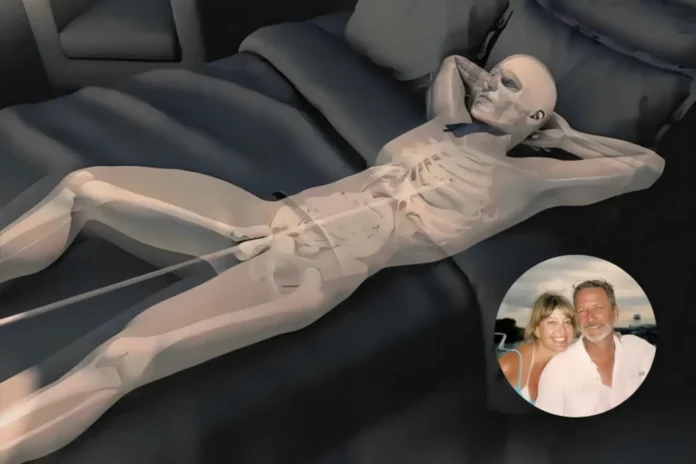
55-year-old oil industry executive Greg Fleniken checked in Room 348 of the MCM Eleganté Hotel in Beaumont, Texas. An habitual business traveler from Lafayette, Louisiana, Greg was a man of routine. He was found the next morning on the floor, still fully clothed and with a cigarette still in his hand. The interior door of the hotel was closed. His wallet, phone, and more than $1,000 in cash lay untouched.
“There was no blood, no damaged furniture, no sign of a struggle,”
said Detective Scott Apple of the Beaumont Police. Early speculation centered on natural causes most likely a heart attack. As Apple noted at the time,
“It looked like he just dropped dead.”
But the truth was far stranger.
Jefferson County medical examiner Dr. Tommy Brown performed the autopsy. What he found immediately overturned the early assumptions. Greg’s internal injuries were catastrophic: broken ribs, a lacerated liver, holes in his stomach and heart, and a small wound on his scrotum. Yet there were no external bruises, no obvious bullet wound, and no defensive injuries.
“This was not a heart attack, This man was murdered.”
Dr. Brown stated.
The scrotal wound was initially thought to be a bruise, but Brown would later conclude it was an entry wound. The pliable skin had sealed after death, concealing its true nature. With no bullet recovered and no weapon in the room, investigators were left with a mystery.
The homicide ruling intensified pressure, but Detective Apple’s investigation soon stalled. No one had heard gunfire. No suspects emerged.
“We were spinning our wheels,”
Apple admitted. Greg’s widow, Susie Fleniken, decided to take action. She hired Ken Brennan, a former DEA agent turned private investigator, to re-examine the case.
Brennan joined forces with Apple and re-visited Room 348. There, he noticed a tiny hole low on the wall that shared a boundary with Room 349. In the adjacent room, they found a matching hole filled with dried toothpaste.
“That was the breakthrough, It was obvious someone had tried to cover it up.”
Brennan said.
Investigators learned that Room 349 had been occupied by three union electricians from Wisconsin. They had spent the night drinking heavily. One of them, Lance Mueller, had pulled out a pistol to show off. He accidentally fired a round, which tore through the wall and struck Greg as he relaxed watching television.
The bullet’s path was devastating: it entered through the scrotum and traveled upward, shredding internal organs before lodging in his chest. Greg likely lived for several minutes, unaware of what had just happened.
The electricians did not report the shot. Instead, they plugged the wall hole with toothpaste and said nothing.
“They assumed no one was hurt, That assumption cost Greg his life.”
Brennan later said.
Nearly two years after Greg’s death, Lance Mueller confessed. He pleaded no contest to manslaughter in 2012 and received a 10-year prison sentence. Two coworkers, Tim Steinmetz and Trent Pasano, cooperated with authorities after initially keeping silent.
A tweet from X.
The case is now taught in forensic circles as a lesson in investigative diligence. A hole barely the size of a pencil eraser cracked the mystery open.
“If we’d missed that, this case would still be unsolved,”
Brennan reflected.
As Susie Fleniken told Vanity Fair,
“If Ken hadn’t kept pushing, we might never have known what really happened. Greg deserved the truth.”
In the end, a single overlooked clue a small hole in a hotel wall brought justice. This case stands as proof that even the quietest deaths can tell a story, if we’re willing to listen closely enough.

